
Physics
OCR Physics A.
Course Content
Exam board: OCR A Physics
Content is split into six teaching modules:
Module 1 – Development of practical skills in physics
Practical skills assessed in a written examination.
Practical skills assessed in the practical endorsement.
Module 2 – Foundations of physics
Physical quantities and units
Making measurements and analysing data
Nature of quantities
Module 3 – Forces and motion
Motion, Forces in action
Work, energy and power, Materials
Newton’s laws of motion and momentum
Module 4 – Electrons, waves and photons
Charge and current
Energy, power and resistance
Electrical circuits, Waves, Quantum physics
Module 5 – Newtonian world and astrophysics
Thermal physics
Circular motion
Oscillations
Gravitational fields
Astrophysics and cosmology
Module 6 – Particles and medical physics
Capacitors
Electric field
Electromagnetism
Nuclear
Particle physics
Medical imaging
Assessment
HOW MANY EXAMS DO I HAVE TO TAKE AND WHEN DO I TAKE THEM?
Physics A-Level: There are 3 exams totalling 6 hours of exam assessment.
Modelling physics (2 hours 15 minutes) assesses content from Modules 1,2,3 and 5.
Exploring physics (2 hours 15 minutes) assesses content from 1,2,4 and 6
Unified physics (1 hour 30 minutes) assesses content from all modules 1-6.
Within A-Level Physics, approximately 40% of the marks available within written examinations will be for assessment of mathematics.
Practical endorsement
The Practical Endorsement in OCR A A-level Physics assesses students’ practical skills throughout the course. Students complete a range of required practical activities (PAGs), during which teachers assess their ability to use equipment safely, follow experimental procedures, collect and analyse data, and work independently. Teachers assess students against the exam board’s practical competency criteria over time, awarding a Pass or Not Classified. The Practical Endorsement is reported separately from the A-level grade and does not contribute to the final A-level grade, which is determined entirely by the three written examination papers.
HOW IT WILL BE TAUGHT
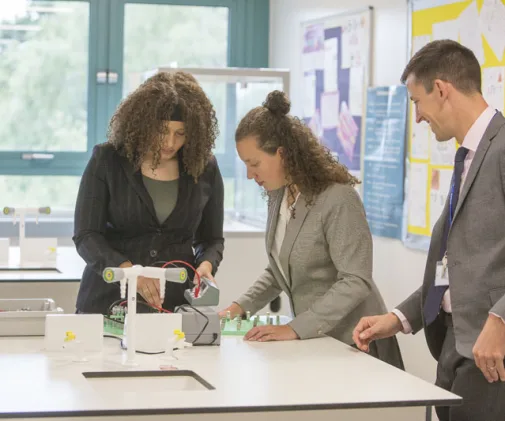
Following the OCR A Physics specification, students develop their understanding through practical experiments, demonstrations, scientific investigations and exam-style problem-solving. Lessons combine theory with hands-on learning, including the required practical activities (PAGs), data analysis, graph interpretation and uncertainty calculations. Mathematical skills are embedded throughout the course, helping students apply Physics principles to unfamiliar contexts and develop the confidence needed for A-level examinations and further study.
SPECIFIC ENTRY REQUIREMENTS
A strong foundation in Mathematics and Science is essential due to the mathematical and analytical demands of A-level Physics. A GCSE grade 7 in Mathematics is recommended, alongside grades 6–7 in Physics or Combined Science.
FUTURE OPPORTUNITIES
A-level Physics provides an excellent foundation for university degrees, higher and degree apprenticeships, and careers in engineering, astrophysics, medicine, computing, renewable energy, scientific research and emerging technologies.
RESOURCES
Students have access to specialist laboratory equipment, practical investigation opportunities, subject-specific textbooks, scientific simulations, online learning platforms and a wide range of examination practice materials to support their learning and develop their confidence.
Where do I go to find out more information?
Miss A Hunter – abbie.hunter@finhampark2.co.uk
Course content – AS and A Level – Physics A – H156, H556